
Italy Fermata 14: Crespi d'Adda
tl;dr where and when everything fits in your gaze

Crespi d’Adda’s context, both spatial and temporal, doesn’t add up. It doesn’t look like it belongs where it is, halfway between Bergamo and Milan. And almost certainly not from the time it was completed, a century ago.
If you stand on the knoll, the appropriately named Punto Panoramico Belvedere situated in one of the town’s corners, you can see the whole panorama. A large chimney reaching like an obelisk in the sky is on the right, indicating the factory that sits by the narrow riverbank. A church steeple, a bit shorter, points to an open small town square in the middle. On the left and in the distance is a cemetery and a mausoleum that, though not as tall as the chimney nor the steeple, seems to cast an ominous shadow with its dark facade. And then almost directly below are the houses which paint a picture of suburban bliss. They are photostats: two stories in the middle of a square plot of land surrounded by a low fence. They fit neatly in a grid, with wide residential roads between them. Everything fits in your gaze, like you could fit the town in your back pocket. If you had asked a six year old from the Northern hemisphere to draw you a happy town where people live and work, Crespi d’Adda is what you would get.


If you had asked me this, when I was six or a bit later, I would have given you the 3D image. I was not good at nor a fan of drawing, but give me a space and some objects and I was your architect1. I like assembling. Nobody even had to ask me actually, I would just decide that on this day I was going to “build a town” in my room, on the floor, using all of my toys. Two conditions: every toy had to be used and every toy had to earn its place within the workings of the town. It had to make sense. It had to have a plan: the toy cars, the transformers, the Alf doll, the parking garage, the globe, the plush doll, the he-man and other action figures, the models and construction sets. What were going to be the houses? How were the roads going to be arranged? Could the Lego bricks be repurposed? How do the Smurfs get to school? Could the He-Man Battle Bones serve as a form of public transport to lessen the traffic for the Hot-Wheels?
This was an activity I did quite frequently in my grandmother’s flat, where I lived for the first 9 years of my life. The flat that sat on top of the Sarajevo brewery, an ornate building of the 1880s, with a rich red facade, rooms with high ceilings, and a daily aroma of hops and yeast that came in from the windows that faced the inside of the working compound. Within an hour or so from pulling all of the toys out on the Turkish carpet, a town would spring up and the rest of the day was spent in manipulating and dwelling within the world that the town suggested. I was playing SimCity in the analogue days. I did not have the words for this concept at the time, given that socialism was my country’s current religion, but I felt the power of being a God. I had made a world. And I was a benevolent God, I did not enact any “natural disasters” (build it just to destroy it). And I had done all of this in a single morning. I was also a productive God. An invested God, who got stuck in the details and well-being of the citizens. I was also quite evangelical, and could preach the gospel of my urban toy planning to my cousins, who were not very receptive to my message. I really was God.2 Until I was told by powers higher than me to put everything back to where it was and neither my gran nor my parents would let me take them on a tour beforehand.
The “gods” of Crespi d’Adda had the plains of Lombardy, as their Turkish carpet on which to build their town. Chiara, who had brought me here in the evening after a day scaling Bergamo, was beaming with local pride at this heritage site. She said that what I was seeing was the realisation of a utopian vision of one man (and expanded upon by his son) who wanted to build an ideal all-in-one place where the employees of his cotton factory could both work and live. Their kids could even go to school here. In almost a corporate-campus kind of way. At least for the time. In the late 1800s the working and living conditions for the masses here were the opposite. This was going to be, it turned out to be, the worker’s village, surrounded by forest, a state-of-the-art mill by the river where you work, shops and church in the middle, and a short walk back home to relax in your two storey with a picket fence. Are you working at the factory? You get a picket fence! 9 to 5 on the factory floor? You get a picket fence? Every worker gets a picket fence! This business tycoon’s socio-capitalist dream did its thing, the factory only stopped in 2004, the town is now a protected heritage site and looks as fresh as it might have a century ago. And people still live here, descendants of those who got the first house keys.
For me, walking in between the picket fences was uncanny. Every image I carried of Italy was shattered: it is not what I expected to find in this country. It was familiar for what it was but unfamiliar for where it was. Crespi D’Adda, particularly walking in between its picket fences, flew me straight to North America, and the time I had spent there as a teenager and also as an undergrad. The houses, the roads, the picket fences, the inflatable pools in the back gardens together with the lawn mowers, the church in the centre, even the trees… I was walking from class through the quiet suburbs of the province of Quebec. This made Crespi seem uncanny and left me unsettled.


The only way I could make sense of it was to see it as a movie set. For a story set in 1950s white suburban America. It looked just like it. And it was so quiet, clean, curated. I was waiting to hear someone say “…and ACTION!" The opening of David Lynch’s Blue Velvet could have been shot here (I never did get past the opening scene because of the red ants in the grass of the picket fence gardens). Even the light felt like it came by request of a seasoned DOP (as in Director of Photography, not Denominazione d’Origine Protetta as it is frequently found on food labels in Italy).
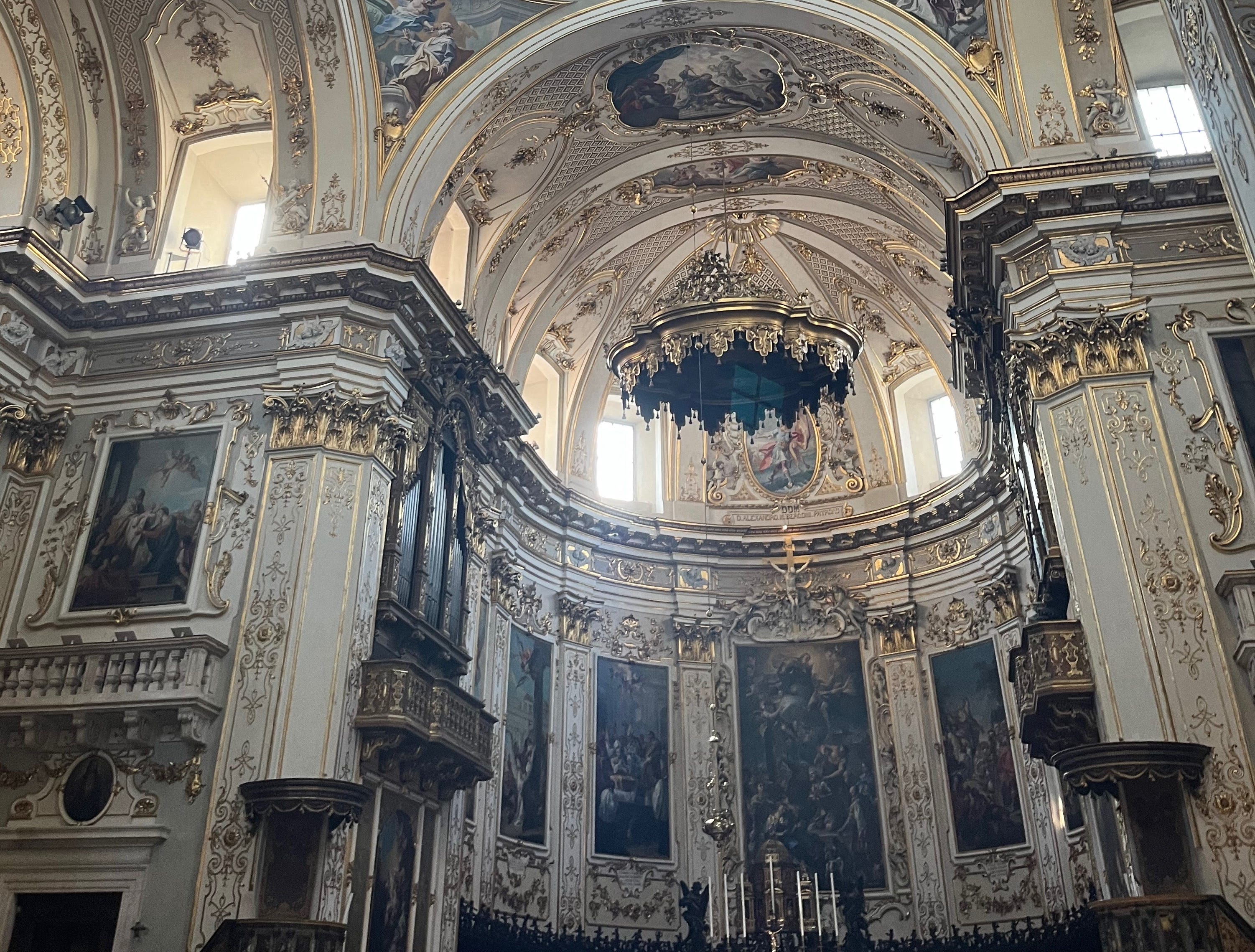
Earlier that day, when walking through Bergamo with Chiara, we entered a basilica in the Città Alta where there was not much sunlight. Just like many such religious buildings in Italy, the outside world is closed off by the ancient doors. They are kept closed so the inside lights can draw your eyes to the artworks, the statues, the frescoes, and the tapestries. As if you entered a cinema in the middle of a sunny day. Here in the Cathedral of Sant’Alessandro, I looked up at the frescoes and artworks, each framed under a different arcade, as if they were different panels. Taking my gaze from one to another, I could finally follow the flow of the story they were presenting. I felt the figures animate. Not that I had a religious awakening, but that I finally felt what these images could do. It dawned on me that for those who lived here centuries ago, entered the space, closed the door to their place and time, and looked upon this, moving the eyes as I did… it must have transported them. Just as cinema has that power today to make you step into a world. They stepped into the story of the past. How could you not get stirred by what you saw? How can you not receive these images, and have them not alter how you behave? You couldn’t leave them behind as you stepped back through the door into your day, they were in you.
For the people who entered Crespi d’Adda for the first time to work there, what was that like? They probably did not see it as a child’s idyllic drawing made manifest, definitely not a movie set. Was it out of their world? Did they see it as an image of the future that they could walk into? How did they find it? Perhaps one can only feel the full power of an image when you place yourself in the eyes of someone who was around to see it soon after it was made.
While I felt uncanny in the middle of this image of North American suburbia in Crespi d’Adda, Chiara was inspired by the nature, the houses, and the arrangement of the town, the proximity of work and home. Though we might all encounter the same things, their images fly us to different places and times.


The sun never set, we got a seat in the outside garden, grapevine covered, of one of only a couple of restaurants in town. Plenty of Lombardians out for their evening meal, but not many tourists from what I gathered. My uncanny feeling was comforted by the familiar comforts of pasta (casoncelli), pizza and tiramisu (with certified D.O.P. to elevate the freshness of taste). Chiara and I sat, sharing plates, each carrying a different image of the same town. To her, it spoke of a place she would like to live in her future and for me, a place I wanted to leave in my past.
I wrote about this when walking through Bari, but Crespi d’Adda overwrites that resonance.
Years later, I would spend nearly a decade on a PhD where I tried to re-use theatrical images from other plays to assemble a new performance. Only now as I write about this memory do I realise that my town was my earliest form of bricolage and should have been included in my literature review.