
Italy Fermata 13: Bergamo
tl;dr: history - funiculars - her story

In my hometown of Sarajevo, a flat walk of a kilometer takes you through a few centuries. As a kid, I did the walk every weekday. Architecture, history, a whole mood shifted from the old Turkish part of town, through the Austro-Hungarian, and finally into the socialist. Bergamo is similar, but transposed. Flipped so that history travels top to bottom. Don’t worry, there are a few cute funiculars to assist with the time travel. Funiculars photogenic enough to warrant having a whole symmetrically arranged scene in a Wes Anderson film.
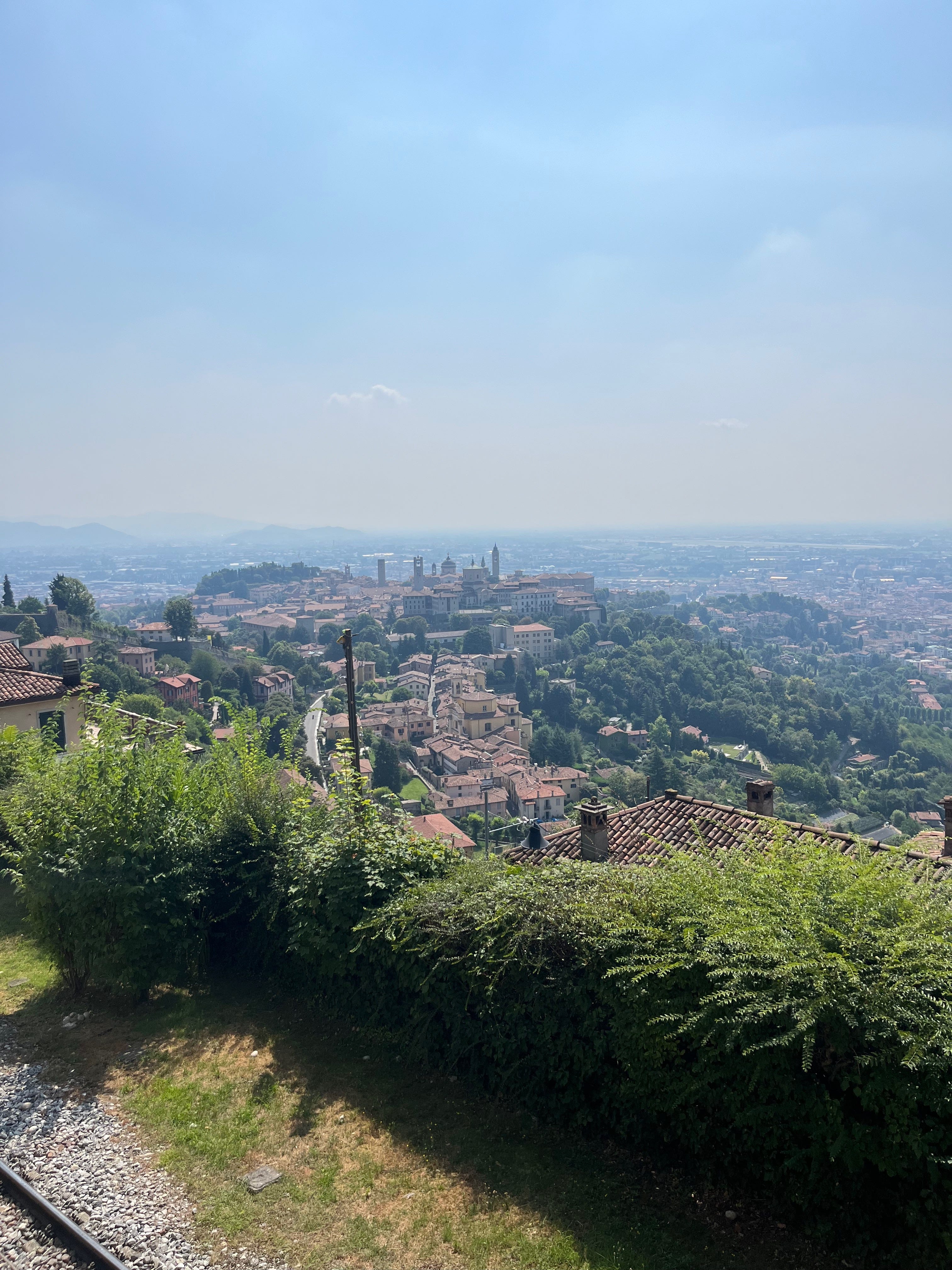
The old town, Città Alta, is at the top of a hill (well, a couple of them), with its walls encircling narrow cobbled streets connecting numerous chapels and cathedrals. You think you are on the summit, but there is a very quaint funicular that can take you a further 100+ meters up, from which you can see this old Bergamo, then below it the more recent one, then looking up you can take in all the suburbs and regions. Valleys to the south and onto Milano, hillsides to the north that lead up to the Alps.


When I finally completed Calvino’s Invisible Cities, I could imagine his take on Bergamo. There would always be another hill, and another funicular to take you up. But on top of each hill you would be served the region’s favourite and most deceptive dish, a Polenta e Osei. And you wouldn’t know until you bit in if you were getting the savoury or the sweet version. The savoury is actual cornmeal polenta topped with strips of meat, while the sweet version is a sponge cake, made to resemble the savoury version through its creative use of marzipan and sugar, but filled with hazelnut cream in the middle and topped with a black marzipan bird at the top. They are replicas of each other in looks. And if you guess wrong, you would have to climb the next hill manually instead of getting in a funicular.


I knew that I was picking the sweet variety of the Polenta e Osei, in a cafe just on the outside of the old town’s city walls. It was delicious, and it was not even 9 in the morning yet. Across from me, and watching me having this audacious breakfast, was Chiara. I was going to spend the day with her as my very own Marco Polo, to introduce me to Bergamo. Chiara is one of those unique individuals I met at an academic conference that I actually kept in touch with (I am not very good at even meeting people at a conference, much less keeping in touch). She spotted my foreign self on the #6 bus from Trieste to the ICTP some five years prior when we were both on our way to attend a data steward summer school. Given that we were both employed at university libraries, we bonded quickly. We even made a point of finding the host institute’s library so we could compare it to our respective ones. As a proud native of Bergamo, she said that whenever I found myself in Italy again, I would have to stop by her hometown so she could share it with me.
And she did. In a single day, not only did I acquire a multitude of images of Bergamo’s spaces, both indoor and outdoor, ancient and more contemporary, but of course she took me into the libraries too, both to the one belonging to her university just outside the old Venetian city walls and the historical city one with antique globes and books nearly half a millennium old. We negotiated the maze-like connections between the churches, cathedrals, chapels, even nunneries in the old town, that sometimes come with a three-dimensional map just outside. We journeyed through history, even rode the funicular to get the top view, and then made our way down to the wide avenues of downtown Bergamo that are frequented more by those who live and work in the area. The old town seems angled towards a tourist approach, especially in terms of residence, for the sightseers and the devoutly inclined. Plenty of tastes of Bergamo, including the savoury original take on Polenta e Osei, thick slices of rectangular pizza, and its Lombard pasta variety of “casoncelli”. Something about the rustic oily oiliness of the oil, fresh fat out the cooking pan, took me to my own grandmother’s cooking (who also used to make us polenta on the weekends).


But I also got an image of what life looks like for a resident of Bergamo and its surrounds. Through spending a day with Chiara, though she had shifted her schedule and taken the day off to show off her town to me, I got a feel for her routine. Her existence in her hometown. Spending so much of the trip thus far on my own, navigating countless cobbled streets and seeing the sights, I had spent a lot of time wondering what a day for a person living in Cremona, Bari, or Napoli was like. After all, a citizen of Cape Town might not take to the winelands, beach or Table Mountain every day. One might not even see the ocean. What I had been subconsciously doing in each of these towns that I visited as a tourist was trying to imagine being their inhabitant. I finally got that chance in Bergamo with Chiara. Perhaps there was even a small tension, with her wanting to show me the high-lights and me subtly wanting to see the everyday-lights instead. Her presence and openness shifted my gaze from the sights to the human story. Maybe I was hoping to satisfy my curiosity, to get a sharper image of what a version of me inhabiting Bergamo would be doing.
And a lot of this was revealed through stories in conversation, and working in a similar field, in institutions that are far apart geographically, but organisationally connected with similar issues always provide that starting point. We could talk library work politics, doing further studies while working, career progression, lack of resources for repositories, academics’ lack of respect for libraries... and then we could enter into the more personal, the family, the relationships between parents and their children, the logistics that get in the way of the future, the past experiences that shaped the moment of now. Bergamo was the background, a beautiful and very tasty one, to the human connection. I understood when Chiara lamented the Bergamo old town of her youth, and how much more variety and personality it had then compared to now, where it caters very much to tourists and not those who once lived there. We laughed at the bartender’s child who was enjoying the cool aircon too much in his parents’ workspace on this warm day. I even got an opportunity to quickly meet Chiara’s very grown children, after having heard about them for many years, as we stopped by her house outside the town before she dropped me off. This was all her Bergamo, a day in her-story. She was proud to share it with me.
A vividly described tour - your words are a delight.