Italy Fermata 10: Reggio Emilia
Tl;dr: pondering home in someone else's piazza

Sunday evening, peak July. Sun is still bright but not as strong. I amble through a few calm squares of Reggio Emilia. Calm and relaxed, and yet all around me are people sitting and talking in cafes. Whole families have their kids running or cycling or pushing some wheely thing around, or running through those water fountains. An adjacent green park has benches for seats for both the old and very young. Voices echo and travel, but not as a cacophony of noise. There are enough pockets of silence to make out distinct voices, even conversations.
None of the people on this Sunday evening Reggio Emilia piazza look Italian. By that I mean, none of them fit my first image of an Italian. There are no sock-less white men with crisp linen pants, no nonnas with a hunch and a bag full of vegetables. They don’t look like tourists, nor do they feel like them, they don’t have that kind of vibe. The reason the piazza is clam and relaxed is because it is devoid of that collective heaving tourist energy that renders a place’s aura stressful. No, these people and families are dwelling in their space. It is their square, their park, their cafes. Their home?


At this point i have two intersecting thoughts.
The first thought is that I am supposing a lot here. i am making up a narrative, a story out of my own imagination which draws from my repertoire of memories, experiences and images. I am supposing that these people have migrated from other parts of the world to be here, to be able to dwell in this park on a sunny summer evening in July. But let me check myself in these thoughts. This is an assumption born out of privilege, who am I to judge what an Italian looks like, and to whom Italy belongs? I am walking around it freely because of a passport from favourable country, but a few decades back and I would have struggled to get into this place. Is this scene distorting my images of an Italian town on summer evening?
The second thought is an image. Walking amongst these pockets takes me back in time and space - yet the action and feeling is the same. The bell had just rung. From the 4th period class to the locker to get your lunch, and then the same kind of amble to find your pocket of people. It is lunch time on the lower ground of my old international school in Addis Ababa: a gentle green slope broken up by counters of low stone ledges, with a teacher’s tukul in the middle. Pockets of us were scattered everywhere, in little huddles of all geometric shapes. Most people stuck to having lunch with people form their own grade, and the boys and girls tended to have their own circles (the Americans tended to keep to themselves). But there were the cool kids, the fashion kids, the geeks, the nerds, the athletes - and most of these had a natural international feel. There was a chance that in each of these huddles, no country was represented more than once. At the time, we were only starting to understand geo-politics (How many died in your country today? At least they are not starving to death.) and took each other company at face-kid value through shared interests or exchangeable lunches (Sanjin, you only ever have sandwiches!). Why does this image come to me now? Except that maybe it is that same feeling - i am catching the same feeling walking through these streets as i did stepping out to lunch back in that school. And that feeling, maybe not at the moment, but how my mind had chosen to remember it was that the lunch period felt like home, just like this feels like it carries a home energy.
The question at the intersection of these thoughts:
Where is home?
What is home?
On one level, I would say that this place doesn’t seem like home of those I see around me. But who I am to make that call? What images do I hold for those who I think should call Italy home? What right do I have to carry that thought. I have been asked - where is home? Is home a nation, is home the house, is home the family? Is home where you can go out to relax on a Sunday afternoon with your family? Perhaps people move from one nation to another to ensure something different for their family. Maybe to ensure that that they have a safe place to go on a summer Sunday evening. Am I reading too much into this scene before me to think that these families find themselves in Reggio Emilia to make something different for their families? The family is home and whatever country the family is in, then that is home.
I think I only started understanding migration I became a migrant myself. I am not sure if you can fully understand it unless it happens to you or you do the same - unless you pack up (if you have a chance) and go - not like a tourist - not to walk through new Reggio Emilia or stop in parma eat a risotto - you have to leaving knowing you won’t come back. And sometimes you choose to migrate, but in some cases - immigration finds you. Up until the Bosnian war, my view of the world was quite rooted (and perhaps it is where this image of Italy and its inhabitants still resides or was forged). There wasn’t much migration or people moving into Sarajevo from other countries in the 1980s (and definitely not the 90s). So i thought that your nation or your birth within a nation defined your home. Only after finding myself in Ethiopia while the Bosnian war started did I realise I couldn’t go back to my home and had no more nation. And home at to be found elsewhere, like with those at lunch at school.
What will this square in Reggio Emilia, look like in a couple of decades on a similar Sunday afternoon? Who will be here, what language(s) will they speak, where will they call home, and who will be the tourist visiting them? Will the image of a person who calls Italy home be different to the one I hold today?
One of my favourite Bosnian authors, who was out of the country when the war started, wrote that a place becomes a home when you find “your own” places in a new place. Hemon found his butcher and his barber in Chicago. The people around me have found their piazza.
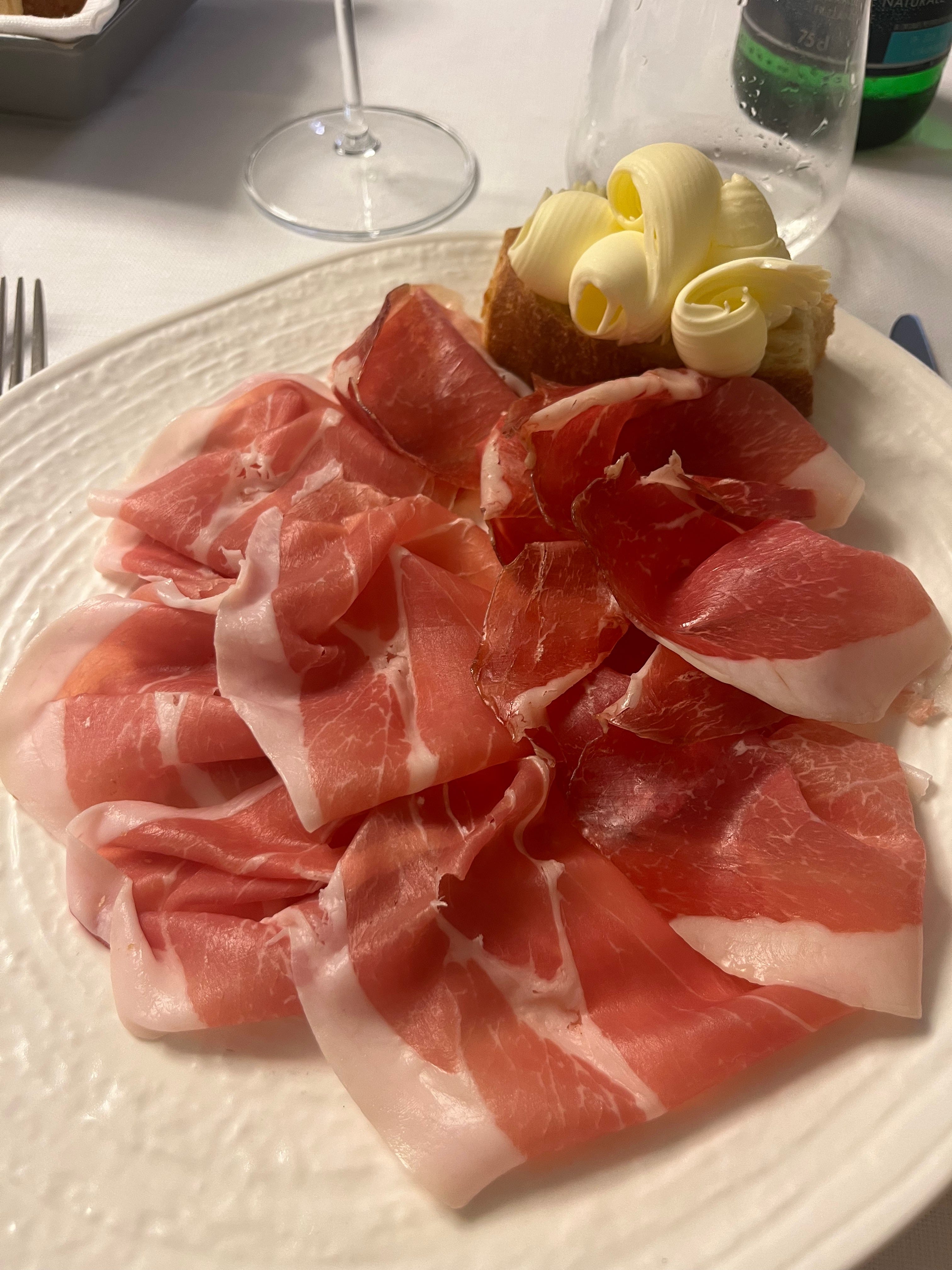
In nearby Parma the next day, I skip the sightseeing around piazzas and decide to treat myself to an authentic lunch that is not a sandwich nor a panini. In a classic Parma restaurant I order the individual ingredients: ham, risotto and the whippiest of all butters. I also find out, that this restaurant, with the local specialities, the owner moved here from the south of Italy.